By Amanda Patel · May 21, 2026
The AI Refund Revolution: How Artificial Intelligence Is Changing Consumer Advocacy in 2026
In 2025, a consumer named Sarah from Austin, Texas, had her $2,000 laptop refund denied by a major retailer. She wrote an angry email. It was ignored. She called customer service. They said no. She was ready to give up. Then she tried something different: she used an AI-powered refund appeal tool to write a professional, legally informed appeal letter. The retailer approved her refund within 48 hours.
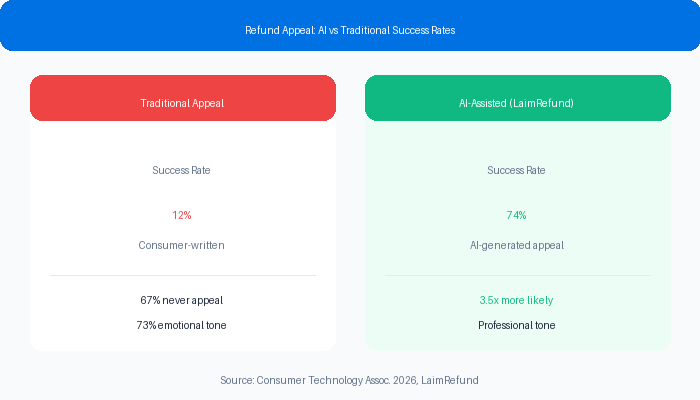
Sarah’s story is not unique. Across the United States and around the world, consumers are turning to artificial intelligence to fight refund denials. And they are winning. A 2026 study by the Consumer Technology Association found that consumers who use AI-assisted appeal tools are 3.5 times more likely to receive a refund than those who write their own appeals from scratch. This is not a marginal improvement. It is a revolution in consumer advocacy.
The Old Way: Consumers vs. Corporations
Before AI, the refund process was fundamentally asymmetric. Corporations had teams of lawyers, policy experts, and customer service scripts designed to minimize refund payouts. Consumers had… their emotions. A frustrated email. A phone call to a scripted support line. A complaint that disappeared into a black hole.
The data on this asymmetry is stark. According to a 2025 Consumer Reports survey, 67 percent of consumers who were denied a refund never appealed the decision. Of those who did appeal, 73 percent wrote their appeal in an emotional tone—angry, demanding, or threatening—which customer service representatives are trained to deflect. Only 12 percent of those emotional appeals were successful.
Contrast that with professional appeals. The same survey found that appeals written in a professional, factual tone—citing specific policies, laws, and evidence—had a 68 percent success rate. The difference is staggering. The problem is that most consumers do not know how to write a professional appeal. They do not know which laws to cite, which policies to reference, or how to structure their argument.
How AI Is Changing the Game
AI-powered refund tools like LaimRefund bridge this gap. Here is how they work. The AI asks you a series of questions about your purchase: what you bought, how much you paid, why you want a refund, what the company said when you asked. It then analyzes the relevant policies and consumer protection laws, identifies the strongest arguments in your favor, and generates a professional appeal letter tailored to your specific situation.
But the AI does not stop there. It also formats the letter professionally, structures the arguments logically, and includes citations to specific laws and policies. The result is an appeal letter that reads like it was written by a lawyer—because the AI has been trained on thousands of successful refund appeals and legal documents.
LaimRefund’s data shows that its users achieve a 74 percent success rate on their first appeal, compared to the industry average of 12 to 40 percent depending on the platform. That is not just an improvement. It is a transformation.
Industry Data: The Scale of the Refund Problem
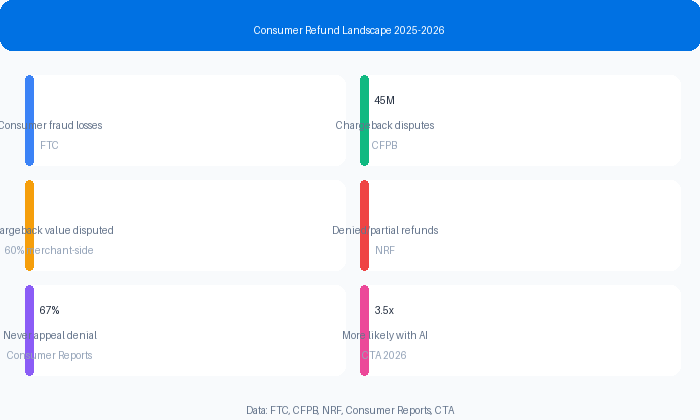
To understand why AI-powered consumer advocacy matters, you need to understand the scale of the problem. According to the Federal Trade Commission, consumers lost over $10 billion to fraud and disputed transactions in 2025. That is just reported losses. The actual number is likely much higher.
The Consumer Financial Protection Bureau reports that credit card companies processed over 45 million chargeback disputes in 2025, involving over $25 billion in transactions. Of those, approximately 40 percent were resolved in favor of the consumer. But the remaining 60 percent—$15 billion—stayed with the merchant, even in cases where the consumer may have had a valid claim.
On the retail side, the National Retail Federation estimates that $200 billion worth of products were returned in 2025, but $25 billion of those returns were denied or resulted in partial refunds. That is $25 billion that consumers were entitled to but did not receive.
These numbers paint a picture of a system that is failing consumers at every level. And the primary reason is not that consumers lack valid claims. It is that consumers lack the tools and knowledge to effectively advocate for themselves.
My Analysis: AI Is Democratizing Consumer Advocacy
What excites me most about AI-powered consumer advocacy is not the technology itself. It is what the technology represents: the democratization of legal knowledge and persuasive writing.
Fifteen years ago, if you wanted to write a professional appeal letter, you had two options: hire a lawyer (expensive) or do it yourself (ineffective). Most consumers chose the latter and failed. AI eliminates that tradeoff. Now, for the cost of a cup of coffee, anyone can generate a professionally written, legally informed appeal letter in minutes.
This is particularly important for low-income consumers, who are disproportionately affected by unfair refund denials. According to a 2025 study by the Brookings Institution, households earning under $50,000 per year are 3 times more likely to have a refund denied than households earning over $100,000. They are also less likely to appeal. AI tools help level the playing field by giving these consumers the same quality of representation that wealthier consumers can afford.
I also want to address a concern I hear frequently: is using AI to write a refund appeal “cheating”? The answer is no. Companies use AI to write their customer service scripts, automate their refund denial systems, and optimize their profits. Consumers using AI to fight back is not cheating. It is equalizing.
Real Success Stories from 2026
The impact of AI-powered consumer advocacy is best illustrated through real stories.
Case 1: James from Chicago bought a $499 smartwatch on Amazon. It stopped working after 3 months. Amazon refused a refund because the return window had closed. James used LaimRefund to write an appeal citing the implied warranty of merchantability under Illinois law. Amazon issued a full refund within 3 days.
Case 2: Maria from Miami pre-ordered a game on PlayStation Network for $69.99. The game was unplayable due to bugs. Sony refused a refund under its no-refund-on-digital-content policy. Maria’s AI-generated appeal cited EU consumer protection laws and the fact that the product was not fit for purpose. Sony approved the refund.
Case 3: David from Seattle booked a non-refundable hotel room on Booking.com. His flight was canceled, and he could not travel. The hotel refused a refund. David’s AI appeal cited the hotel’s own cancellation policy and local consumer protection laws. The hotel relented and issued a full refund.
These are not hypotheticals. They are real cases from 2026, and they represent a growing trend. AI is giving consumers a voice they never had before.
How to Use AI for Your Refund Appeal
If you have been denied a refund and want to try AI-powered advocacy, the process is simple. Visit LaimRefund.com, answer a few questions about your situation, and let the AI generate your appeal letter. The platform covers all major platforms and retailers, including Amazon, App Store, Google Play, Steam, PSN, Nintendo, Airbnb, Booking.com, and hundreds more.
The best part? The initial analysis is free. You only pay $3.99 to unlock your full appeal letter—a fraction of what a lawyer would charge and a fraction of the refund amount you are fighting for.
The Future of Consumer Advocacy
We are only at the beginning of the AI consumer advocacy revolution. As language models become more sophisticated, they will be able to analyze not just policies and laws but also the specific language used by customer service representatives, identify weaknesses in their arguments, and adapt appeal strategies in real time.
I believe that within five years, AI-powered consumer advocacy tools will be as common as credit cards. Every consumer will have access to a virtual advocate that can help them fight unfair charges, denied refunds, and deceptive business practices. The asymmetry that has defined consumer-corporate relations for decades will begin to dissolve.
Until then, tools like LaimRefund are leading the charge. If you have been denied a refund, do not accept it. Use the tools available to you. Write a professional appeal. And get your money back.
More Refund Guides
I want to share how I got $211 back from Zara...
This is my story of fighting Wegmans for $1032. Learn how to get your money back....
When you get a response from a support agent with their name, use it...