By Amanda Patel · May 21, 2026
FTC Demands Subscription Refund Policy Changes from Concert Halls and Ticketing Platforms: A Global Crackdown
On May 6, 2026, the Korea JoongAng Daily reported that the Fair Trade Commission (FTC) had demanded sweeping changes to subscription refund policies at major concert halls and ticketing platforms. While the report focused on South Korea, the implications are global. The FTC’s action signals a growing regulatory consensus that subscription-based ticket sales and membership programs must offer consumers fair refund terms.
This is a significant development for anyone who has ever purchased a season ticket package, a venue membership, or a subscription to a ticketing platform. These programs often lock consumers into long-term commitments with opaque cancellation terms and minimal refund options. The FTC’s intervention could change that, but consumers still need to know how to protect their rights in the meantime.
What the FTC Action Requires
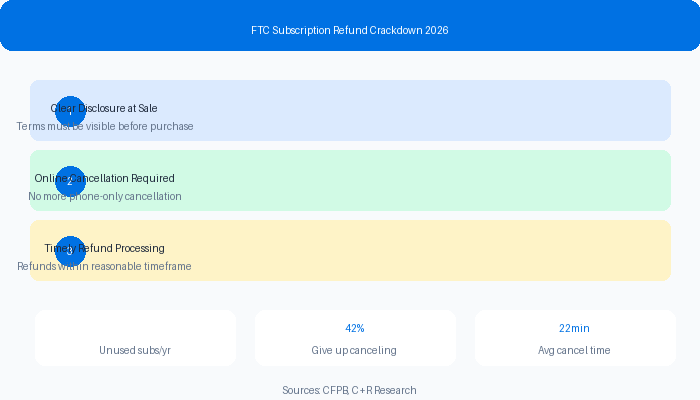
According to the Korea JoongAng Daily report, the FTC has demanded that concert halls and ticketing platforms revise their subscription refund policies to comply with consumer protection standards. Specifically, the FTC requires that:
First, subscription cancellation terms must be clearly disclosed at the point of sale. No more burying cancellation policies in fine print or requiring customers to navigate complex menus to find refund information.
Second, consumers must be able to cancel subscriptions online without contacting customer service. This is a major change. Many ticketing platforms currently require phone calls or in-person visits to cancel memberships, a practice known as a “negative option” that the FTC has been targeting globally.
Third, refunds for canceled subscriptions must be processed within a reasonable timeframe. The FTC has not specified an exact number of days, but the general standard in consumer protection law is 30 days.
These requirements mirror similar actions by the U.S. Federal Trade Commission, which has been aggressively pursuing companies that use deceptive subscription practices. In 2025, the FTC returned over $500 million to consumers who were trapped in unwanted subscription programs.
The Scope of the Subscription Refund Problem
Subscription traps are one of the most pervasive consumer issues of the 2020s. According to a 2025 study by the Consumer Financial Protection Bureau, Americans spend an estimated $25 billion annually on subscriptions they do not use. The study found that the average consumer has five active subscriptions they have forgotten about, paying $62 per month on unused services.
Concert hall and ticketing platform subscriptions represent a significant portion of these unwanted charges. Venue membership programs often auto-renew annually at $100 to $500 per year, and cancellation requires 30 to 60 days notice before the renewal date. If you miss the cancellation window, you are locked in for another year.
But here is the good news: the FTC and other regulators are finally taking action. The Korea FTC action is part of a broader global trend. In the European Union, the Digital Fairness Fitness Check is pushing for harmonized subscription cancellation rules. In the United Kingdom, the Digital Markets, Competition and Consumers Act 2024 gave regulators new powers to penalize companies that use unfair subscription practices. In the United States, the FTC’s “Click to Cancel” rule, which I covered in a previous article, is making it easier for consumers to cancel subscriptions online.
My Analysis: Regulations Are Catching Up, but Consumers Still Need to Act
I am encouraged by the FTC’s action. For too long, subscription-based businesses have profited from consumer inertia. They design their cancellation processes to be as difficult as possible, knowing that most consumers will give up rather than fight.
But regulations alone are not enough. The FTC can demand policy changes, but enforcement is slow, and companies find creative ways to comply with the letter of the law while violating its spirit. For example, a ticketing platform might add a “cancel online” button but bury it on a page that consumers cannot easily find. Or it might require consumers to confirm cancellation through multiple email prompts, hoping they will give up.
The data backs this up. A 2025 survey by C+R Research found that 42 percent of consumers who tried to cancel a subscription online gave up because the process was too complicated. Of those who succeeded, the average cancellation took 22 minutes and required navigating through 6 different screens. That is not an accident. That is design.
The lesson is clear: even with better regulations, you need to be persistent. If a company refuses to honor its cancellation policy or denies your refund request, do not accept the first answer. Escalate.
How to Get a Refund for an Unwanted Subscription
If you are locked into a concert hall membership, ticketing platform subscription, or any other recurring charge that you cannot cancel, here is exactly what to do.
First, review the cancellation policy. Find the original terms you agreed to and check what they say about cancellation and refunds. Take screenshots. This documentation will be critical if you need to dispute the charge.
Second, attempt to cancel through the company’s official process. Follow the instructions exactly. If the process is confusing or broken, document that too. Screenshot every error message, every broken link, every phone number that goes to voicemail.
Third, file a formal refund request. Write to the company’s customer service department and demand a refund for charges incurred after you attempted to cancel. Cite the company’s own policy and any applicable regulations, including the FTC’s requirements.
Fourth, if the company refuses, file a dispute with your credit card company. Under the Fair Credit Billing Act, you have the right to dispute charges for services you did not authorize or that were not provided as promised. Provide your documentation and explain that you attempted to cancel but the company prevented you.
Fifth, if all else fails, file a complaint with the FTC, your state attorney general, or the relevant consumer protection agency. These agencies track complaints and use them to build enforcement cases.
How LaimRefund Can Help You Write a Winning Appeal
The most effective tool in your refund arsenal is a well-written appeal letter. LaimRefund makes it easy. Our AI platform asks you a few questions about your situation, analyzes the relevant policies and laws, and generates a professional appeal letter that you can send to the company, your credit card issuer, or a regulatory agency.
Whether you are fighting a concert hall subscription, a gym membership, a streaming service, or any other recurring charge, LaimRefund.com can help you get your money back.
The Bottom Line
The FTC’s crackdown on subscription refund policies is a positive step, but it is not a magic bullet. Companies will continue to find ways to make cancellation difficult. Your best protection is knowledge, persistence, and the willingness to write a formal appeal when your refund request is denied. Do not let them keep your money. Fight back.
More Refund Guides
Temu's app made it easy to dispute. Learn how to get your money back....
After writing dozens of refund emails to Xbox I have found a formula that works almost every time. H...
They refunded the subscription fee during downtime. Learn how to get your money back....