By LaimRefund Team · June 02, 2026
Trader Joe's FACTA Settlement 2026: How to Claim Before June 9
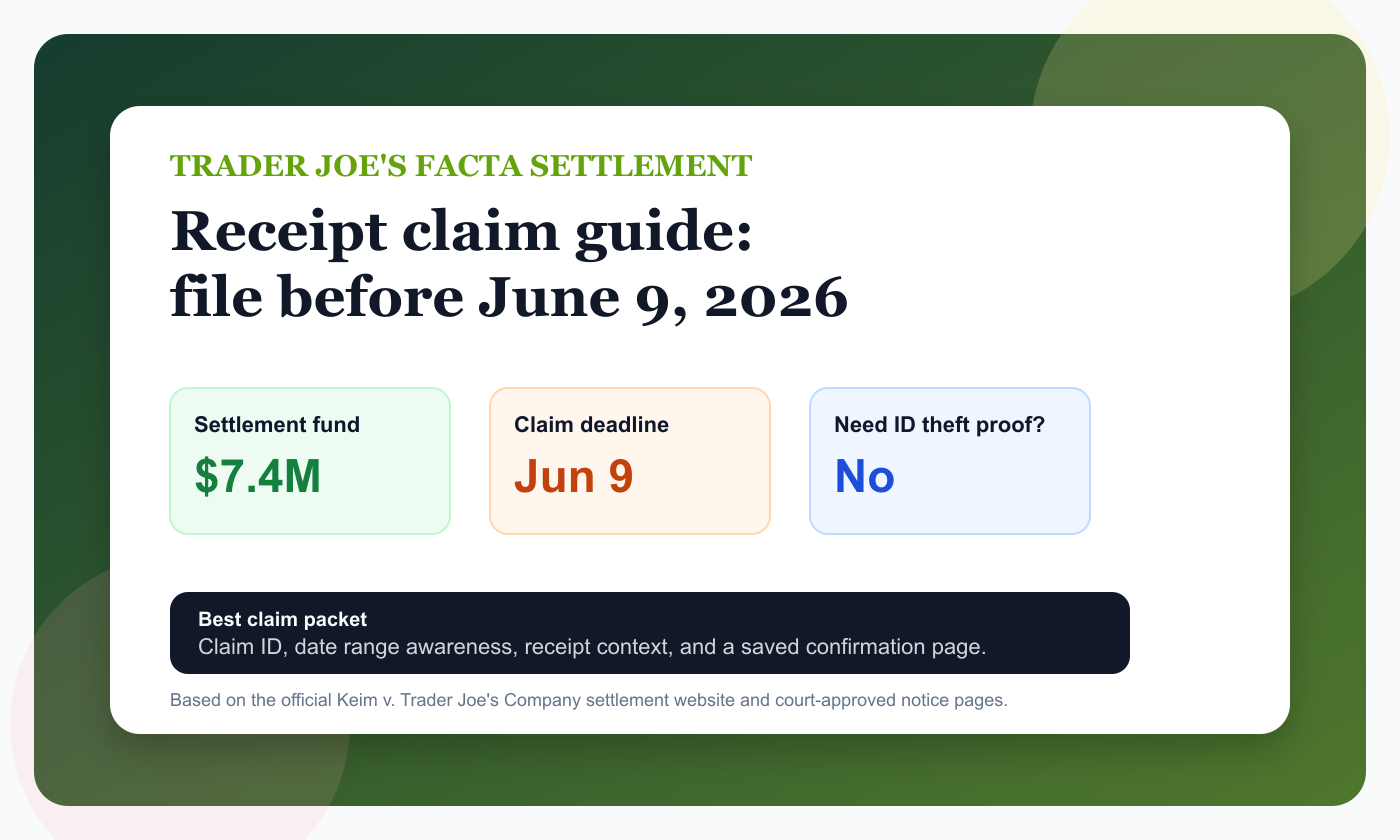
Trader Joe's FACTA settlement claims close on June 9, 2026, and the easiest way to get denied is to assume the case is about identity theft instead of receipt formatting and class-list matching. If you received notice or think you qualify, the right move is to verify the official site, file on time, and keep a clean proof packet.
Introduction and Main Problem Explanation
The official Keim v. Trader Joe's Company settlement website says that if you submit a valid Settlement Claim Form by June 9, 2026, you may receive a payment from the $7.4 million settlement. The underlying allegation is not that every class member suffered fraud. It is that Trader Joe's allegedly printed credit or debit card receipts showing the first six and last four digits of the card number in violation of FACTA during the covered period.
That detail matters because many consumers read a settlement notice like this and ask the wrong first question. They ask whether they suffered identity theft. For a FACTA claim, that is usually not the threshold issue. The threshold issue is whether your transaction belongs to the settlement class and whether you file correctly before the deadline. The official settlement website is explicit that identity theft is not required to prove the claim.
This makes the claim structurally different from a data breach settlement. In a data breach case, documented fraud or identity theft often changes the payout. In a receipt-printing case, the class match and the filing workflow matter more. That difference is exactly why people lose money: they build the wrong evidence packet and ignore the parts that actually control eligibility.
The settlement materials also make clear that the administrator can seek additional information from claimants to validate claims. That means careless filings are a risk. If your information does not match what the administrator expects, or if you file outside the covered conditions, you can still be denied even if you shop at Trader Joe's regularly today.
The fastest way to lose money in a settlement is to confuse the claim path with the story path. The story path is what happened to you. The claim path is what the administrator actually needs to approve payment: a class definition match, a deadline, and the right identifiers.
Consumers also tend to over-assume that a no-proof claim means no records matter. In reality, records still protect you if the administrator asks follow-up questions, if your notice was lost, if your address changed, or if you later need to choose between a flat payment and a documented-loss claim.
A disciplined file usually includes five things: the notice email or letter, the official settlement URL typed directly into the browser, a screenshot of the important dates page, any receipts or statements tied to the issue, and a copy of the final claim confirmation. That packet is much more useful than relying on memory weeks later.
Scam risk is part of the workflow now. Real settlements often look odd because they use standalone domains, third-party administrators, and claim IDs. That means a legitimate notice can feel suspicious. The safe move is not to ignore every message. The safe move is to verify the case name, administrator, deadline, and official website before you type anything.
Search demand around these topics is practical and urgent. People search for whether a settlement is real, what deadline applies, whether proof is required, how much documented losses are worth, and whether they can still sue if they do nothing. A strong SEO article has to answer those concrete questions in plain language.
The practical SEO angle is obvious. Searchers want to know whether the Trader Joe's settlement is real, whether identity theft proof is needed, how claim IDs work, and whether they can file without a notice letter. A useful article has to explain that the legal theory is narrow, the deadline is hard, and the best filing behavior is boringly precise.
Step-by-Step Guide
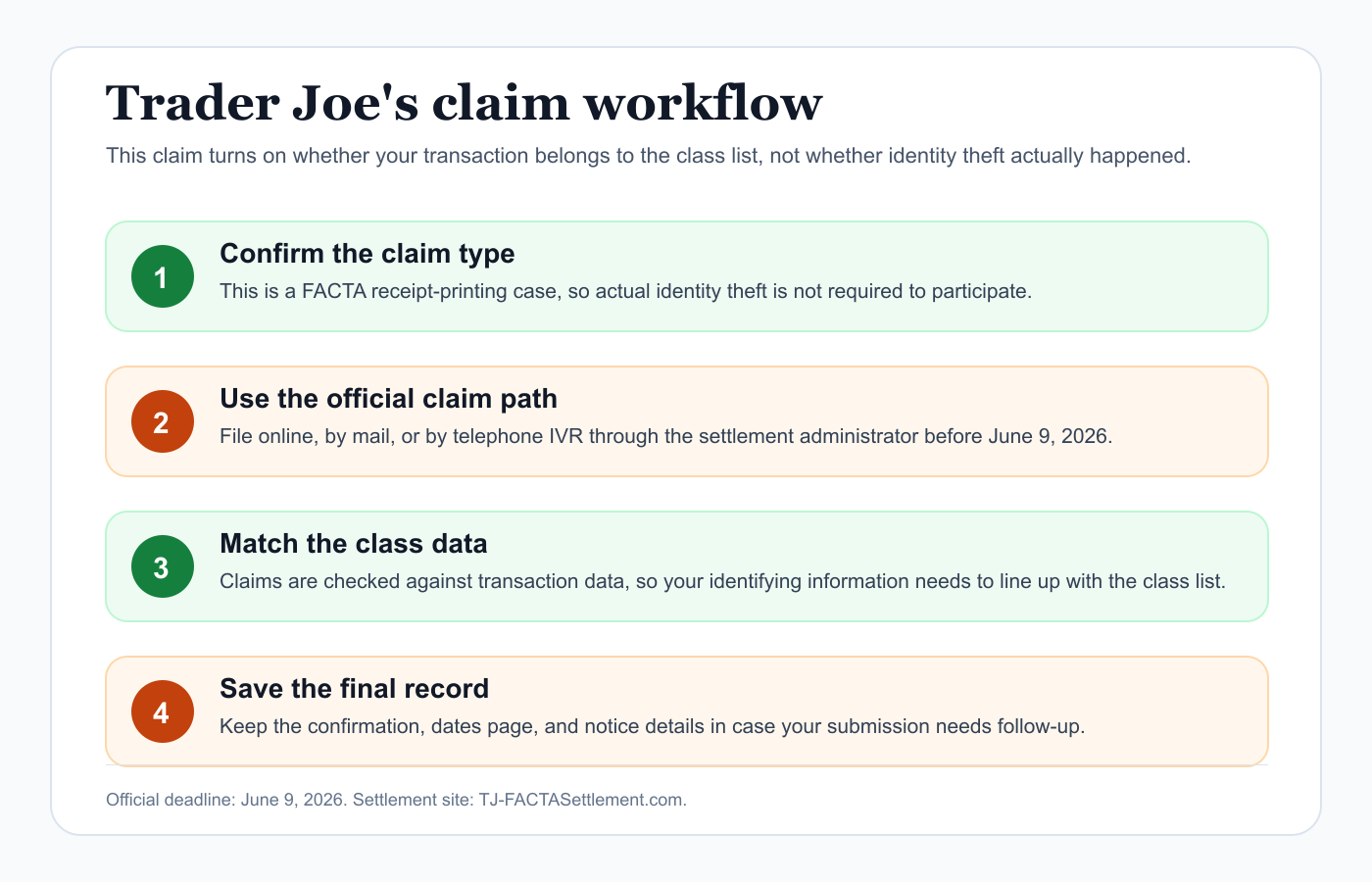
- Open the official settlement website directly at TJ-FACTASettlement.com and confirm that the Claim Filing Deadline is June 9, 2026.
- Read the basic information page and confirm that the claim relates to receipt printing practices and the specific class period, not to generalized shopping activity at Trader Joe's.
- If you received a notice, use the Class ID from that notice when you start the online, phone, or mailed claim path.
- If you did not receive a notice, read the site carefully before filing and be prepared to provide the identifying details the administrator uses to cross-check claims against transaction data.
- Do not add irrelevant identity-theft narrative unless the administrator specifically asks for it. This claim is about class membership and valid filing, not a documented loss ladder.
- Save screenshots of the important dates page, the claim submission flow, and the final confirmation number or confirmation email.
- If you are unsure whether you want to be bound by the settlement, decide before the deadline whether to file, object, or exclude yourself instead of waiting until after June 9.
- Keep your settlement file separate from any bank fraud disputes or credit card claims, because those are different processes with different standards.
The claim itself is not complicated, but it rewards people who slow down enough to understand what the class actually covers. The administrator is not paying for a broad feeling that receipts are risky. The administrator is paying claims that fit the defined case.
Comparison Table
| Question | What Usually Matters | What Does Not Usually Control | Best Evidence |
|---|---|---|---|
| Do I qualify? | Whether your transaction fits the class definition and class list | Whether you still shop at Trader Joe's now | Notice, Class ID, transaction context |
| Do I need identity theft proof? | No, not to assert the FACTA claim itself | A fraud story by itself | Official site language and claim instructions |
| How do I file? | Online, mail, or phone/IVR by June 9, 2026 | Sending random support emails to Trader Joe's | Claim confirmation and date screenshots |
| What is the main filing risk? | Mismatch with transaction data or a late claim | Being too detailed about unrelated harm | Saved claim copy and notice data |
Checklist and Security Callout
A clean FACTA settlement filing is more like a matching exercise than a complaint letter.
- Official settlement URL is verified.
- June 9, 2026 deadline is saved in your calendar.
- Class ID or identifying details are available before you start.
- You understand this claim does not require proof of identity theft.
- Confirmation page or confirmation email is saved.
- You know whether you are filing, objecting, or excluding yourself.
Tip: A notice that looks plain or unfamiliar is not automatically fake. Settlement websites often use stripped-down domains and third-party administrators. What matters is whether the case name, phone number, deadline, and court-approved language line up with the official site.
There is another practical angle here that matters for consumers who are skeptical of tiny-looking claims. Trader Joe's settlement notices may reference estimated payments rather than guaranteed payments because the final per-person amount depends on how many valid claims are filed and what deductions the court approves. That does not make the claim suspicious. It is how pro rata settlement funds usually work.
If you are helping a parent, spouse, or former housemate file, pay attention to who actually used the card and who received the notice. Settlement administrators care about matching records. Filing under the wrong person because you share an address can create needless friction.
Do not confuse this case with a loyalty-program dispute, data breach, or bank fraud event. The best Trader Joe's filing is narrow. It names the case, uses the class information provided, and avoids adding facts that do not help the administrator answer the only question they have: does this claim fit the class and the submission rules?
That discipline is exactly the same habit that improves refund appeals. Whether the issue is a settlement claim, a subscription renewal dispute, or a denied charge reversal, the path to a better outcome usually starts with classifying the problem correctly before you start typing.
Product Connection
LaimRefund is useful when consumers have to decide whether to file a settlement claim, ask a merchant for a direct refund, or escalate through a billing platform. The tool helps turn a loose story into a tighter timeline and evidence packet.
That matters because many support failures happen upstream of the actual law. People attach the wrong records, ask the wrong party for money, or blur three different remedies into one message. A cleaner case structure often changes the result.
Scan your domain now. Ten seconds.
FAQ Section
Do I need identity theft proof to file a Trader Joe's FACTA settlement claim?
No. The official settlement site says identity theft is not required to prove a FACTA claim. The key issue is whether your transaction falls within the class and whether you submit a valid claim on time.
What is the Trader Joe's settlement deadline?
The official settlement website lists June 9, 2026 as the deadline to submit a valid Settlement Claim Form.
Can I file if I did not receive a notice letter?
Possibly, but you should read the official site carefully and be ready to provide information that can be matched against class data. Claims that do not match the class list can be rejected.
Is this Trader Joe's settlement a scam?
The safest approach is to type the official settlement URL directly, verify the case name and deadline, and avoid any site that asks for fees, crypto, or bank login credentials.
What happens if I do nothing?
If you do nothing, you will not receive a payment, and depending on the settlement terms you may still be bound by the release unless you opt out properly. Read the official site before letting the deadline pass.
Related Internal Links
- MUBI Auto-Renewal Settlement 2026: Claim Before June 9
- Subscription Auto-Renewal Refunds: What FTC Cases Mean for Consumers
- Check Your Refund Case
Source: Keim v. Trader Joe's Company Settlement Website (June 2, 2026). Official claim, deadline, and class information for the Trader Joe's FACTA settlement
More Refund Guides
When Spirit Airlines denied my refund I did something unusual. Learn how to get your money back....
I want to share how I got $119 back from Kroger...
I want to share how I got $1746 back from Timberland...