By LaimRefund Team · June 09, 2026
Western Union Fraud Payout 2026: Who Can Still File a Claim and What Scams Qualify
The Western Union fraud payout story is different from the usual class settlement because it sits between government compensation and consumer scam recovery. People searching in 2026 usually want to know whether the claim process really reopened, whether their scam type counts and what records still matter years after the original transfer. Those are exactly the questions that deserve a practical answer.
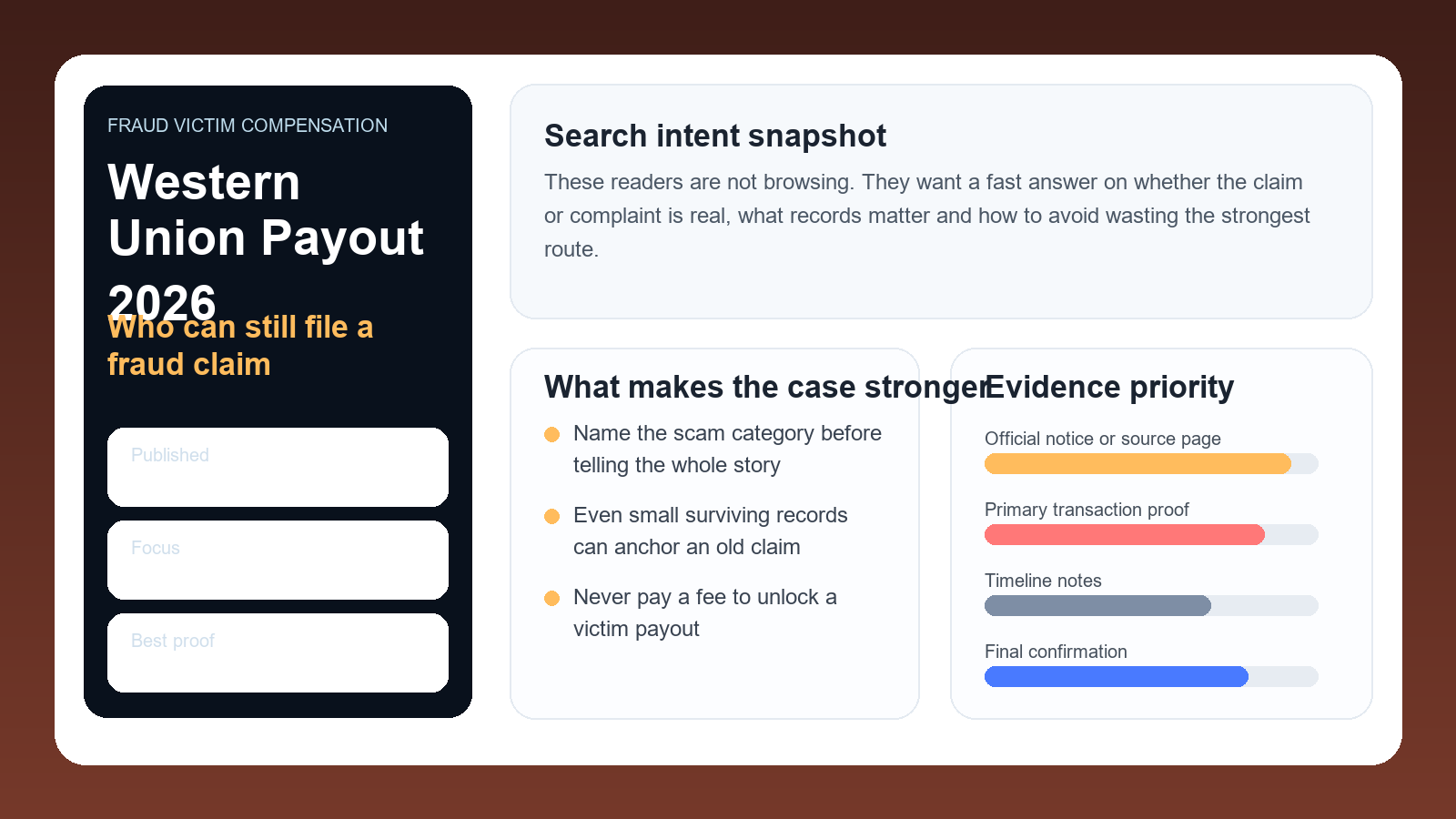
Introduction and Main Problem Explanation
ClassAction.org reported on June 4, 2026 that more Western Union settlement payouts are available because the Department of Justice has reopened the petition process for certain fraud victims. That immediately creates strong search intent: Western Union payout 2026, Western Union fraud claim, Western Union scam reimbursement, and can I still file a Western Union claim. These are not passive searches. They are action searches from people who lost money or from family members trying to recover it.
This topic also stands out because many victims assume the window closed years ago. The original compensation process already had multiple phases, so a reopened filing opportunity can feel suspicious even when it is legitimate. That uncertainty is exactly why a clear article matters. Readers want to know whether the programme is real, what scam categories qualify and whether small claims under two hundred and fifty dollars are worth filing.
The first important point is that this is not a normal merchant refund dispute. The claim is tied to fraud transfers processed through Western Union and to a government-backed compensation process linked to earlier enforcement. The useful records are therefore money transfer details, scam category information, victim identity records and any prior petition history, not ordinary customer-service complaints about a product or subscription.
The scam category matters more than many people realise. ClassAction.org's summary of the reopened process points to familiar fraud patterns such as grandparent scams, lottery or sweepstakes scams and romance scams. A clean file should identify which pattern fits your case before you start trying to attach everything. The stronger your description of the scam type, the easier it is to see why the transfer belongs in the programme.
Victims also need a realistic expectation of what proof may still exist. Some people will still have the money transfer control number, emails, police reports or bank statements. Others will have much less. That does not always mean there is no claim, but it does change how carefully you should preserve whatever remains. A faded paper record becomes far more valuable once you realise the filing door has reopened.
This is also a strong SEO topic because the search terms are so human. People do not search deferred prosecution compensation mechanism. They search Western Union fraud money back, Western Union romance scam claim and Western Union payout still open. A useful article should meet the reader in those terms while still giving them enough structure to file sensibly.
Another practical issue is the size of the claim. Some victims may decide a smaller amount is not worth the trouble. Yet the reopened process exists because the remaining funds are still available to be claimed. A smaller valid petition is still money that should not be left behind just because the paperwork feels unfamiliar.
Manual review breaks down in scam recovery because victims often carry shame as well as missing records. That emotional load makes it harder to sort the timeline, the transfer and the official claim route. A good article helps by replacing embarrassment with a sequence: identify the scam type, identify the transfer, identify the official process, then save the final submission trail.
The title has to reflect that practical urgency. Western Union, fraud payout, year and the still-file question is the shape most likely to match what victims or their relatives are actually typing.
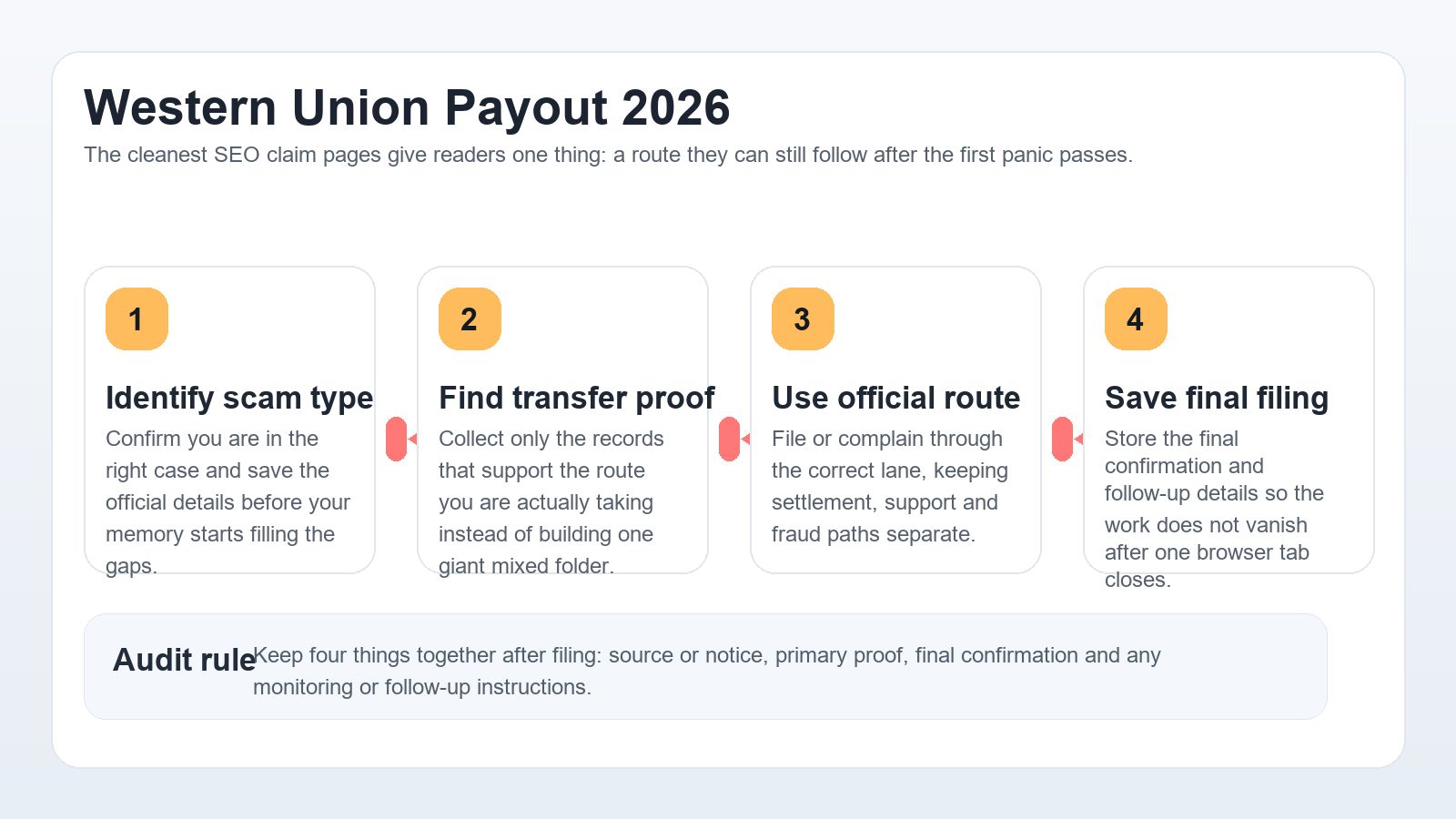
Step-by-Step Guide
- Confirm on the official Western Union victim compensation website or DOJ-linked materials that the reopened petition process still applies to your situation.
- Identify the scam category first, such as grandparent, lottery or sweepstakes, romance or another covered fraud pattern.
- Gather whatever transfer evidence still exists, including the receipt, money transfer control number, bank statement or email record.
- If you filed in an earlier phase, check whether the reopened process asks for new information or only for victims who did not previously petition.
- Write a short timeline showing when the fraud happened, what you were told and why the transfer was made.
- Use the official claim process rather than responding to any third-party message promising to speed up a payout.
- Save screenshots of the final submission pages and any claim or reference number you receive.
- Store the submission confirmation with the scam records in case the administrator requests a follow-up later.
The steps below are designed to rebuild a Western Union claim file even if the scam happened years ago and the records are incomplete.
Comparison Table
| Question | Best Evidence | Why It Matters | Common Problem |
|---|---|---|---|
| Does my scam type qualify? | A short description matched to a known fraud category | Helps the reviewer place the transfer correctly | Telling a broad story without naming the scam pattern |
| Can I still prove the transfer? | Receipt, MTCN, bank statement or email trail | Anchors the claim to a real transaction | Assuming old records are too small to matter |
| Is the payout process real? | DOJ-linked or officially referenced claim route | Protects against follow-up scams | Using a copied link from an unknown sender |
| What if I filed before? | Prior petition history or status notes | Shows where the reopened process fits | Starting over without checking prior eligibility |
Checklist and Security Callout
Before filing, identify the scam pattern and the transfer evidence you still have.
- The scam category has been identified.
- Any transfer receipt or bank record is saved.
- The official payout route has been verified.
- Any prior petition history is noted.
- A short timeline of the fraud is written down.
- The final submission confirmation will be stored with the file.
Tip: older Western Union fraud claims are often saved by one surviving document. If you still have a transfer receipt or statement, treat it like the anchor of the whole file.
The easiest mistake in old fraud claims is to start with a vague story instead of a scam category. If the transfer was part of a lottery, romance or grandparent scam, say that plainly and build the file around it.
Do not assume a smaller claim is not worth filing. If the reopened programme covers your transfer and the process is still open, leaving the claim untouched does not create a better opportunity later.
Older records matter even when they look incomplete. A transfer receipt, bank statement or old email can be the anchor that makes the rest of the story believable.
Scam awareness matters here too because real victim-compensation processes often attract fake follow-up offers. Never pay a fee, buy gift cards or hand over unrelated credentials in exchange for a supposed payout.
The most useful thing you can do is build one clear folder with whatever still exists: transfer details, scam context, any prior filing history and the final confirmation once you submit.
Product Connection
Western Union is a useful reminder that money recovery is often less about eloquence than about route selection. Victims lose time when they do not know whether they are filing a scam report, a government compensation claim or a normal customer-service complaint.
LaimRefund helps with that sorting work. Even when the issue is not a conventional merchant refund, the same structure matters: identify the right lane, preserve the strongest proof and keep the request clear enough that another person can follow it quickly.
Scan your domain now. Ten seconds.
FAQ Section
Can I still file a Western Union fraud claim in 2026?
ClassAction.org reported on June 4, 2026 that the petition process was reopened because additional forfeited funds remain available for qualifying fraud victims.
What kinds of scams can qualify for the Western Union payout?
The June 2026 reporting highlights familiar patterns such as grandparent scams, lottery or sweepstakes scams, romance scams and related fraud schemes.
What if I no longer have my Western Union receipt or transfer number?
You should still preserve any remaining bank statements, emails or timeline notes because even partial records can help rebuild the claim.
Is the reopened Western Union payout process real?
Yes, but you should still verify the official route through DOJ-linked materials or the published ClassAction.org report before entering personal information.
Do I need to pay anything to receive a Western Union fraud payout?
No. A real victim-compensation process should not require a fee, gift cards or unrelated credentials to release payment.
Related Internal Links
- Zelle Scam Refund Class Action 2026: What Victims Should Do After a Bank Denial
- Subscription Auto-Renewal Refunds: What FTC Cases Mean for Consumers
- Check Your Refund Case
Source: ClassAction.org (June 4, 2026). More Western Union Settlement Payouts Available as DOJ Reopens Petition Process for Fraud Victims
More Refund Guides
Thai Airways took 9 months to refund a cancelled ticket. Learn how to get your money back....
This might sound ridiculous but I spent 15 days fighting Uber over $142. Learn how to get your money...
After writing dozens of refund emails to Wells Fargo I have found a formula that works almost every ...