By LaimRefund Team · June 02, 2026
Google Play Subscription Settlement 2026: Who Qualifies and What to Do
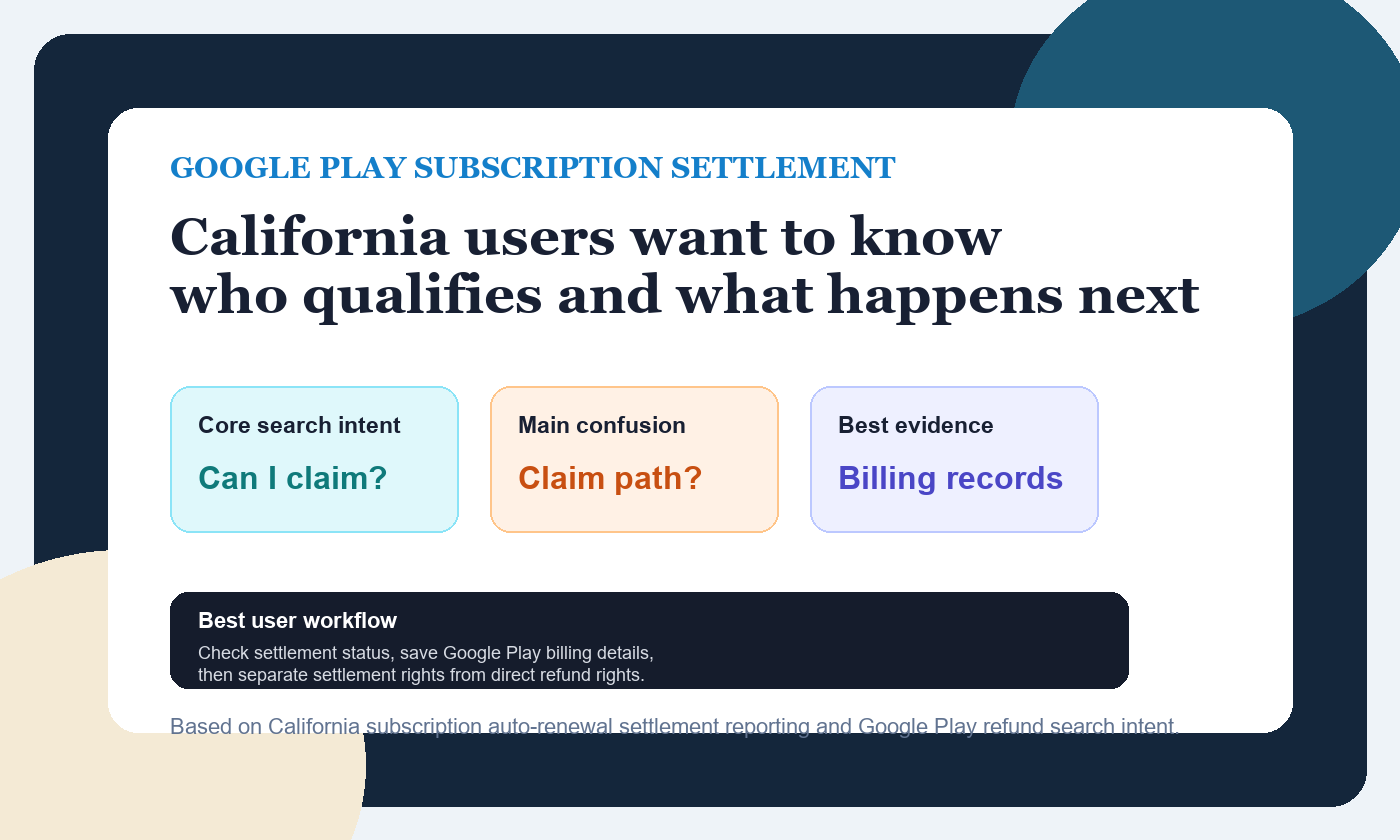
People searching for a Google Play subscription settlement in 2026 are usually not looking for abstract legal commentary. They want to know whether California subscription users are actually entitled to money, whether a claim form exists yet, and what they should preserve now so they do not lose either settlement rights or refund rights later.
Introduction and Main Problem Explanation
ClassAction.org reported that Google agreed to a $5 million settlement resolving claims over allegedly automatically renewing Google Play subscriptions sold to California consumers without compliant auto-renewal disclosures. That headline naturally triggers the search phrases customers actually use: Google Play subscription settlement, Google Play auto-renewal settlement, Google Play California settlement, and Google Play subscription refund after renewal.
Those searches reveal the real user problem. Consumers do not only want to know that a settlement exists. They want to know whether they are in the covered class, whether there is a live claim form, whether payments will be automatic, and whether they should still pursue a direct refund from Google Play or the app developer. If an article does not answer those questions in plain language, it misses the search intent completely.
The most common mistake is blending settlement rights and refund rights into one idea. They overlap emotionally because both involve money that consumers think they should not have paid. Legally and operationally, though, they are different. A settlement usually follows a court timetable, notice process, and administrator process. A refund request follows billing policy, platform rules, and merchant review. A user may qualify for one, both, or neither, and the workflow only becomes clear when those routes are separated.
There is another practical issue. Many California users searching for a Google Play settlement will not have perfect records. They may remember the app name but not the order ID. They may have used a different Gmail address. They may have deleted the renewal email. That does not always destroy their options, but it makes recovery slower and more stressful. Search-driven content should therefore teach evidence preservation before it teaches legal theory.
That is exactly where a refund-focused site has an advantage. LaimRefund readers are already dealing with charges, renewals, disputed subscriptions, and unclear platform rules. A Google Play settlement guide only works if it acknowledges that the user's first need is not symbolism. It is a clean path to action.
British users and international readers also need one extra layer of caution. This Google Play settlement reporting is tied to California auto-renewal law, not to a universal worldwide settlement rule. Searchers outside California often assume that because they found a settlement article, they can file in exactly the same way. A good article has to slow that assumption down without turning cold or legalistic.
The right bridge is practical. First, verify the scope of the settlement. Second, preserve billing evidence immediately. Third, keep your refund request alive if you still have a recent disputed charge. That order matters because settlement timelines move on court schedules, while refund windows can close quickly.
Search intent also tells us what the title should do. Customers are not searching for a clever phrase. They are searching for a direct phrase that matches the problem in their head: Google Play subscription settlement 2026. That is why the title needs the platform name, the year, and the action question embedded naturally.
Step-by-Step Guide
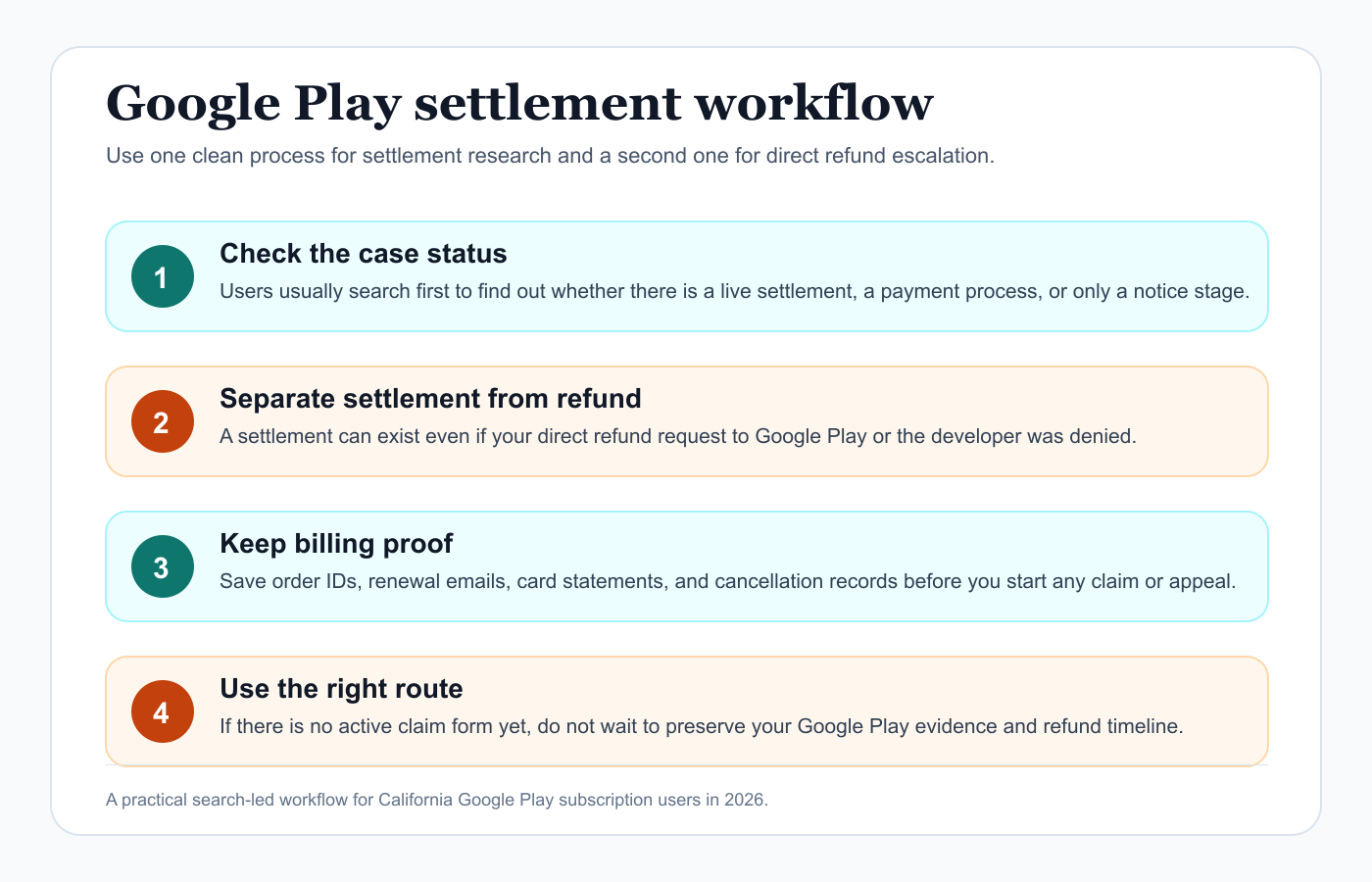
- Search for the case status first, not the payout rumour. Confirm whether the reported settlement has a live official administrator page, a notice phase, or only reporting coverage at this stage.
- Collect your Google Play order IDs, renewal emails, app names, card statement lines, and cancellation records before you begin any claim or refund escalation.
- Check whether your subscription activity and residence fit the California-focused reporting rather than assuming all Google Play users are covered.
- If your disputed charge is recent, submit or preserve your direct Google Play refund request separately from any settlement research.
- Keep any developer correspondence as a separate document set because app-side support evidence may still matter for a live billing dispute.
- If a claim form becomes available, file using the official settlement channel rather than a reposted or affiliate summary page.
- Save screenshots of the official deadlines, FAQ, and claim confirmation if you submit anything.
- If there is no active claim form yet, do not wait to preserve your records. The missing record is often a bigger problem than the missing web form.
The main reason this sequence works is that it acknowledges time pressure on both sides. Settlement processes often take time to mature. Refund windows often do not. Consumers who wait for perfect clarity can lose the faster-moving remedy.
Comparison Table
| Path | Best For | What to Preserve | Main Risk |
|---|---|---|---|
| Settlement tracking | California users checking whether they may be covered by the reported auto-renewal case | Notice details, official links, billing history | Relying on rumours instead of official case status |
| Google Play refund request | Users with a recent renewal charge or disputed billing event | GPA order ID, renewal email, cancellation timing | Missing platform refund windows |
| Developer support route | Users whose issue also involves misleading app-side renewal handling | Support replies, account email, app subscription terms | Confusing app responsibility with platform billing control |
| Card dispute | Users who exhausted merchant and platform review on a specific charge | Denials, screenshots, statements, timeline | Filing too early without exhausting cleaner evidence paths |
Checklist and Security Callout
Use this checklist before you file anything or assume that a settlement story has already solved your billing problem.
- Google Play order IDs are saved.
- Renewal emails or screenshots are saved.
- Any cancellation attempt date is written down.
- Developer replies are kept separate from platform billing records.
- Official settlement status is checked before clicking any claim link.
- Refund and settlement notes are stored in separate folders.
Tip: if a page claims you can unlock a Google Play settlement payment by paying a fee, installing software, or sharing banking credentials, treat it as hostile. Real settlement administrators do not need your bank password to decide whether a subscription case notice is valid.
Security matters more than people admit in refund and settlement work. Searchers often arrive tired, worried, and a little embarrassed that an auto-renewal charge slipped through. That emotional state makes rushed clicks more likely. A calm workflow is a security control as much as a filing control.
The strongest evidence is also the least glamorous. The order ID, the renewal email, the card line, and the cancellation record usually do more work than a long argument about how unfair the charge felt. That is true whether the next step is a settlement claim, a refund request, or a card dispute.
There is also a jurisdiction issue that deserves plain language. A settlement framed around California auto-renewal law does not automatically mean a user in London, Manchester, or Edinburgh can file exactly the same way. The facts still matter. The covered class still matters. The billing records still matter. Good search-led content tells readers what to verify before they assume they are in.
And finally, this kind of case exposes why manual checking breaks down. Most users cannot look at a renewal email chain, Google Play billing page, and app-side settings screen and instantly see which route controls the money. That is not a personal failure. It is a systems problem. Manual review is too easy to derail when platform billing, developer terms, and legal notices all live in different places.
Product Connection
That breakdown is exactly why a tool like LaimRefund exists. The hard part is rarely the first feeling that something went wrong. The hard part is turning scattered platform evidence into a usable route: settlement research, platform refund, developer escalation, or chargeback preparation.
You cannot realistically expect a customer to hold all of those rules in their head and compare them by eye. That is why automation matters here. LaimRefund helps organise the timeline, identify the right billing path, and frame a cleaner appeal when a direct refund is still available.
Scan your domain now. Ten seconds.
FAQ Section
What are people actually searching for in a Google Play subscription settlement case?
The common searches are straightforward: Google Play subscription settlement, Google Play auto-renewal settlement, Google Play California settlement, and whether a user can still get a refund after renewal.
Does a Google Play settlement replace a normal refund request?
No. A settlement and a refund request are different routes. A user may need to preserve both options at the same time, especially if the charge is recent and still within a practical billing dispute window.
What evidence should I keep for a Google Play subscription dispute?
Keep the GPA order ID, renewal email, card statement line, app name, cancellation attempt, and any correspondence with the developer or Google Play support.
If I am outside California, can I still file the same settlement?
Not automatically. Reporting around this case is tied to California subscription users, so readers outside that scope should verify the covered class carefully rather than assuming eligibility.
Why do Google Play subscription disputes feel so confusing?
Because platform billing, developer communication, auto-renewal law, and settlement notices sit in different systems. The confusion is structural, which is why good evidence organisation matters so much.
Related Internal Links
- Google Play Subscription Refund After 48 Hours: What to Do Next
- MUBI Auto-Renewal Settlement 2026: Claim Before June 9
- Check Your Refund Case
Source: ClassAction.org (June 2, 2026). Google settlement ends class action over allegedly automatically renewing Google Play subscriptions
More Refund Guides
Standard script: policy this, terms that. Learn how to get your money back....
This is my story of fighting Hilton Hotels for $1506. Learn how to get your money back....
After writing dozens of refund emails to Petco I have found a formula that works almost every time. ...