By LaimRefund Team · June 02, 2026
June 2026 Class Action Deadlines: 5 Claims You Should Not Miss
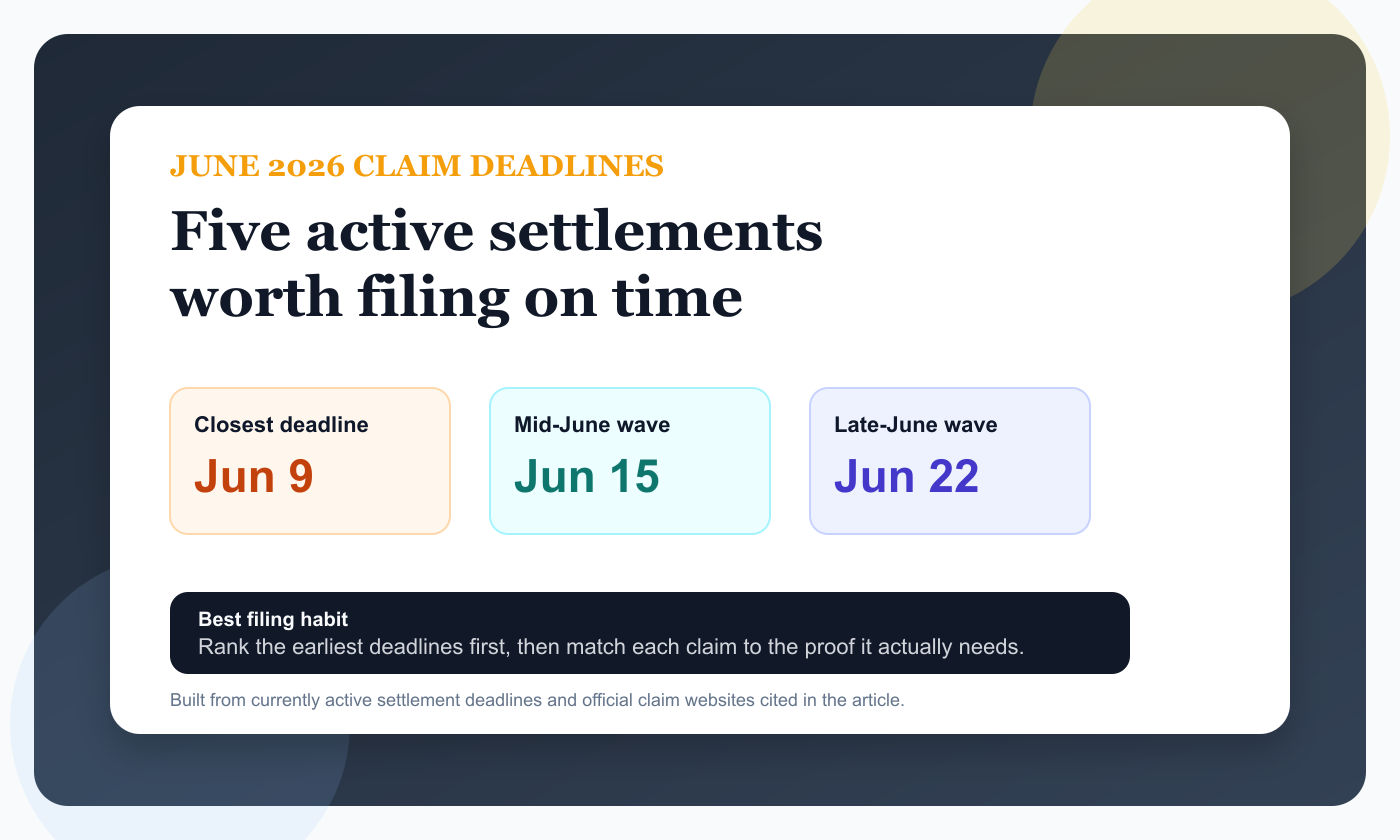
June 2026 has a tight cluster of consumer settlement deadlines, and the biggest risk is not fraud or hard legal language. It is simple deadline drift. When readers are juggling multiple notices at once, the smart move is to rank by the nearest deadline, understand which claims are proof-heavy versus proof-light, and file cleanly before the clock runs out.
Introduction and Main Problem Explanation
A lot of June settlement traffic looks like spam at first glance because consumers are seeing unfamiliar domains, claim IDs, and administrator names in the same week. That creates two bad habits. People either ignore everything, or they rush into the largest headline number without understanding which claims close first.
The better approach is deadline triage. If two settlement claims are both likely valid, the earlier deadline wins your attention first. That sounds obvious, but it is the exact opposite of how most people behave. They often spend an hour researching the biggest possible payout while letting a nearer, easier claim expire.
The second part of triage is claim type. June's active claims include receipt-printing privacy settlements, subscription auto-renewal settlements, robocall settlements, and financial-data breach settlements. Those are not interchangeable. A FACTA receipt case is not a documented-loss breach case. A TCPA robocall claim is not a streaming-subscription refund. The filing logic changes with the case theory.
This is why an overview article is useful even for people who already opened one claim form. The overview helps you see the portfolio. Which claim needs proof of loss? Which claim mostly needs class matching? Which claim has an opt-out date earlier than the claim date? Which one should be handled today rather than this weekend?
The fastest way to lose money in a settlement is to confuse the claim path with the story path. The story path is what happened to you. The claim path is what the administrator actually needs to approve payment: a class definition match, a deadline, and the right identifiers.
Consumers also tend to over-assume that a no-proof claim means no records matter. In reality, records still protect you if the administrator asks follow-up questions, if your notice was lost, if your address changed, or if you later need to choose between a flat payment and a documented-loss claim.
A disciplined file usually includes five things: the notice email or letter, the official settlement URL typed directly into the browser, a screenshot of the important dates page, any receipts or statements tied to the issue, and a copy of the final claim confirmation. That packet is much more useful than relying on memory weeks later.
Scam risk is part of the workflow now. Real settlements often look odd because they use standalone domains, third-party administrators, and claim IDs. That means a legitimate notice can feel suspicious. The safe move is not to ignore every message. The safe move is to verify the case name, administrator, deadline, and official website before you type anything.
Search demand around these topics is practical and urgent. People search for whether a settlement is real, what deadline applies, whether proof is required, how much documented losses are worth, and whether they can still sue if they do nothing. A strong SEO article has to answer those concrete questions in plain language.
For SEO, this kind of article works because it catches deadline-intent traffic before readers land on a single case-specific page. They search for June 2026 class action deadlines, which settlement should I file first, and how to know if a settlement notice is real. Then they branch into the more specific guides.
Step-by-Step Guide
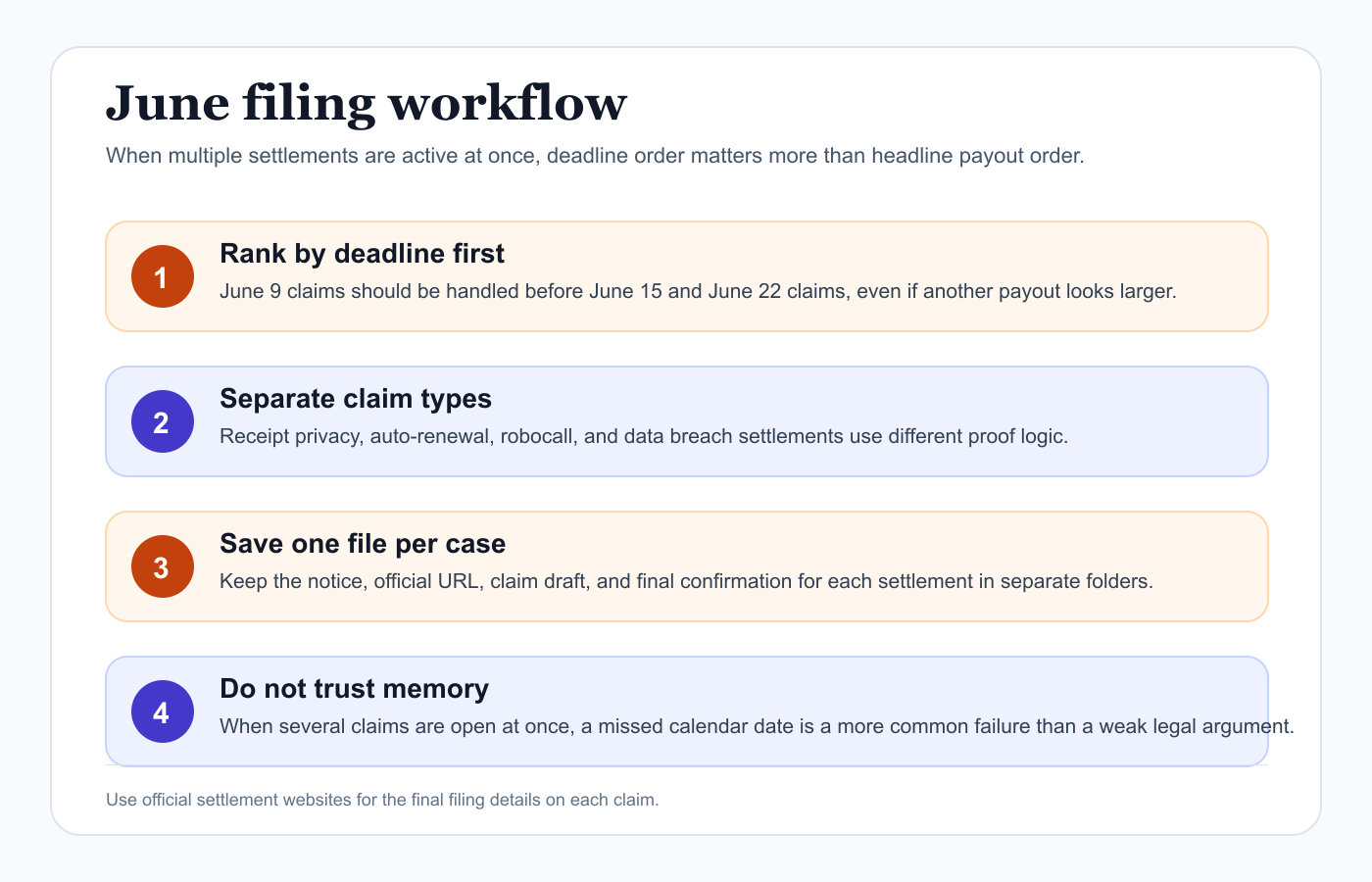
- List every active settlement notice or consumer claim you have right now and put the deadline next to each one.
- File the June 9 claims first, then the June 15 claims, then the June 22 claims, even if the later claims look more lucrative.
- Read the official site for each case just long enough to answer three questions: who qualifies, what proof matters, and what happens if you do nothing.
- Create one folder per case with the notice, official URL screenshot, draft notes, and final confirmation.
- For proof-light claims, focus on valid submission and matching identifiers. For proof-heavy claims, gather statements, invoices, receipts, and fraud records before touching the form.
- If a settlement includes an opt-out or objection deadline earlier than the claim deadline, save that separately so it cannot get buried.
- Submit the claims in date order and keep a log of confirmation numbers and the exact date and time each claim was filed.
- After the claims are filed, activate any monitoring or follow-up benefits instead of assuming the claim itself handles those automatically.
The overview strategy is simple on purpose. The biggest settlement losses usually happen because consumers treat every notice like a brand-new research project instead of building one consistent filing system.
Comparison Table
| Claim | Nearest Deadline | What Matters Most | Best Next Step |
|---|---|---|---|
| Trader Joe's FACTA | June 9, 2026 | Class matching and valid claim submission | Verify notice and file early |
| MUBI auto-renewal | June 9, 2026 | California class fit and renewal/refund status | Check official site and save confirmation |
| SouthState / Register.com | June 15, 2026 | Proof path and class matching | Sort documented vs lighter claims now |
| Krispy Kreme / Lakeview | June 22, 2026 | Documented losses vs simpler cash paths | Build records before the last week |
Checklist and Security Callout
Use this checklist if you are managing more than one settlement claim at the same time.
- Each claim has its deadline in one visible list.
- June 9 claims are handled before mid-June claims.
- One folder exists per case.
- Proof-heavy and proof-light claims are separated.
- Opt-out dates are saved separately from claim dates.
- Every final confirmation is stored right after submission.
Tip: The largest payout on the page is not automatically the most important claim. The most important claim is the one whose deadline you can still realistically meet with the proof you actually have.
This overview is also a good filter for scam detection. When a notice says you must pay a fee to claim, act immediately by crypto, or reveal unrelated credentials, it is almost certainly not a standard court-supervised settlement. Real claims may feel unfamiliar, but they should still line up with a verifiable official site and a readable notice.
Another practical benefit of a deadline overview is that it helps with shared households. If two spouses, parents, or business partners each received notices, one spreadsheet or note can prevent duplicated or conflicting submissions.
The best triage move is to decide which claims are proof-light and which are proof-heavy. A proof-light claim, such as a class-matching filing with a notice ID, can often be cleared in one sitting. A proof-heavy claim, such as a documented-loss data breach submission, deserves its own block of time because you may need statements, invoices, and screenshots before you touch the form. That distinction helps you avoid wasting your freshest attention on the wrong case.
June is also a good example of why internal links matter on a content site like this one. Readers who begin with a deadline overview often need a second article that explains one case in more depth, especially if they are deciding between proof-heavy and proof-light claim paths.
That is the same pattern we see in refund disputes more broadly. The overview catches the confused reader. The specific guide helps them act.
Product Connection
LaimRefund fits neatly into this kind of workflow because it helps users decide which recovery path they are actually on before they waste time writing to the wrong party.
Whether the issue is a settlement claim, an auto-renewal dispute, or a denied merchant refund, the tool helps organize the story into a cleaner evidence-first sequence.
Scan your domain now. Ten seconds.
FAQ Section
Which June 2026 settlement claims should I file first?
File the closest deadlines first. In the current June cluster, that usually means June 9 claims before June 15 and June 22 claims.
How do I know if a settlement notice is real?
Verify the case name, deadline, administrator, and official website independently instead of relying on the forwarded link alone.
Should I prioritize the claim with the biggest payout?
Not by default. Prioritize the claim with the nearest deadline and the strongest proof you can assemble in time.
Do all settlements need the same kind of proof?
No. Some mostly require class matching and valid filing, while others use documented-loss standards. Read the official claim instructions for each case.
What is the safest way to track multiple claims at once?
Keep one folder per case with the notice, official URL screenshot, filing notes, and the final confirmation. That system reduces deadline mistakes.
Related Internal Links
- Trader Joe's FACTA Settlement 2026: How to Claim Before June 9
- Krispy Kreme Data Breach Settlement 2026: How to Claim Before June 22
- Check Your Refund Case
Source: MoneyPilot and Official Settlement Websites (June 2, 2026). Current June 2026 settlement deadlines overview cross-checked against the official claim sites cited throughout the article
More Refund Guides
After months of failed email attempts with a stubborn company, I went old school. Learn how to get y...
Notion Double-Billed Me. A Chat Message Fixed It in 24 Hours. Learn how to get your money back....
I bought tickets to a concert for $350 through Ticketmaster. Learn how to get your money back....